Tampere University and Rector Keijo Hämäläinen made the decisions on the cultural and internationalisation grants on 2 June 2026.
The decisions can be read on the university’s intranet. (English page hasn’t been updated, up to date only in Finnish)
As before, we want to give you some insight into the grant process and the reasonings for awarding the grants. The general criteria for the grants were the same for both grants:
- TREY’s association status
- association notification completed
- an existing bank account and account number
- grant application completed properly on time
In addition to these, for the cultural grant an additional criterion was set requiring that the association’s main purpose is the production of culture or art. The association’s purpose is examined and assessed primarily on the basis of the association’s rules. The criteria were agreed in cooperation between the university and the student union, and were refined as needed as the process progressed.
The cultural grant was applied for on a per-association basis and the internationalisation grant on a per-project basis. In practice, this meant that for the cultural grant a single application per association was sufficient, while for the internationalisation grant several applications could or had to be submitted. The rationale for the chosen procedure is to make processing the grant applications easier on the student union’s end.
Cultural grant
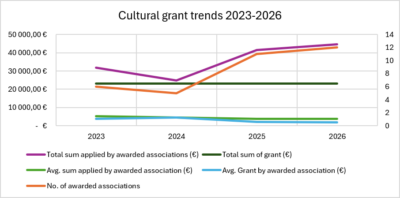
This year a total of 23,000 euros was available to distribute as cultural grants. A grant of up to 5,000 euros could be awarded per association. A total of 85,369.63 euros was applied for, of which 44,553.79 euros was counted as acceptable expenses. Acceptable expenses were costs directly related to performances and shows and the furniture/equipment purchases directly attached to these. No grant was awarded this year for recreation or other incidental costs.
19 associations applied for the cultural grant, of which 12 were determined eligible to apply. For 2026 one larger change was made to the application criteria compared to previous years. This year the cultural grant was a discretionary grant, which, in theory, allows the grant to be directed where the university actually wants it.
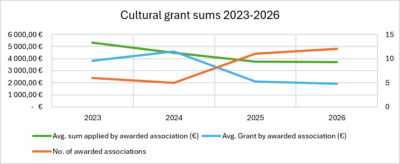
In awarding the cultural grant, a challenge has been identified on the one hand in the growing number of applicants and rising costs of running an association and organising events, and on the other hand in the grant sum that stays the same from year to year. This is reflected in the awarded grant sums. In 2023 the average grant sum per association was about 3,850 euros, and this year only just over 1,900 euros. Over the same period the number of applicants has doubled, as has the number of associations being supported. Similarly, the total sum applied for across associations has also doubled, although the application sums of the supported associations have grown somewhat more moderately (from 32,000 euros to 44,500 euros).
TREY and the university have recognised this problem, and in August we will begin working on student activity grants more broadly.
Internationalisation grant
This year 20,000 euros was available to be awarded as internationalisation grants. A total of about 83,500 euros was applied for, of which about 64,000 euros were acceptable expenses. The rejected expenses were all costs related to the purchase of alcohol. 32 associations applied for the grant, with a total of 107 applications (projects). The share of completely alcohol-free projects of all projects was about 65 percent. The grant was awarded to 18 associations, i.e. 34 projects.
The criteria for the internationalisation grant have been refined and made stricter over the past several years. The reason, simply put, is the large number of applicants. Because the grant decisions are meant to be properly justified and the decision processes are meant to be transparent, this requires an enormous amount of work for the student union, which is responsible for running the grant process. In addition to the general work intensity of the grant process, the grant priorities defined by the university have gradually shifted from generally supporting internationalisation activities towards integrating international students into the working life of Tampere and the rest of Finland. These trends are also visible in this year’s awards. In 2025 one possible project category was also projects that promote the “internationalisation within Finland” of international and Finnish students, but this was removed from the 2026 application criteria.
The projects were assessed by their type according to the call for applications. Applicants gave their own estimate of the appropriate category, but TREY and the university assessed each project and, where necessary, moved a project from one category to another. The categories for 2026 were, in descending order of priority:
- Promote the employment of international students in the Tampere area. (e.g. employment events, company visits)
- Promote the employment of international students outside the Tampere area. (e.g. company visits)
- Promote international students’ orientation to studying and otherwise support studies. (e.g. tutoring, study events)
- Promote international students’ wellbeing and integration into Finnish society (e.g. cultural, sports and hobby events)
In addition to this, the reach of the grant is used as an assessment criterion, i.e. how many international and Finnish students who are TREY members benefit from the grant.
Like last year, the grant was awarded primarily to category 1 projects, after which the remaining sum was allocated to projects in the lower categories. The award sum was sufficient to cover almost the full application sum for every project meeting criteria 1–3. If the projects in these categories had been supported directly to the amount of their accepted expenses, 20,104 euros would have been distributed, which was only slightly over the total grant sum. Because the grant was distributed entirely to projects in categories 1–3, no grant is given to category 4 projects this year at all. The excess 104 euros was levelled out from the category 3 projects so that, from the projects reaching the fewest international TREY students, the necessary amount of calculated grant sum was deducted proportionally. No grant was awarded to projects for which no itemisation of expenses had been made or no project budget had been reported at all.
Because the grant is paid to the association on a per-association basis rather than a per-project basis, the total grant sum proposed for the association was also taken into account in distributing the grant. The minimum sum paid is 50 euros. In practice this meant raising Kasvo ry’s grant by a small amount.
Applied-for projects by category
| Category | Number of projects | Applied grant sum | Number of students reached | Of which international students |
| 1 | 13 | 7,055.00 € | 2,278 | 844 |
| 2 | 10 | 8,394.00 € | 396 | 314 |
| 3 | 11 | 4,655.00 € | 1,574 | 1,235 |
| 4 | 73 | 43,757.00 € | 6,679 | 4,623 |
Supported projects by category
| Category | Proposed grant sum | % grant | Applied / supported | % supported students | % supported intl. students | € / intl. student |
| 1 | 7,055.00 € | 35.3 % | 100.0 % | 53.6 % | 35.2 % | 18.73 € |
| 2 | 8,414.00 € | 42.1 % | 100.0 % | 9.3 % | 13.1 % | 28.55 € |
| 3 | 4,531.00 € | 22.7 % | 96.4 % | 36.4 % | 51.5 % | 8.33 € |
Supported projects by category
Category 1
- Bioteekkarikilta Bioner ry, CV workshop, 200 euros
- Bioteekkarikilta Bioner ry, Get employed in research, 200 euros
- Doctoral Researcher Association of Tampere ry, PhD Pitching gala, 1,000 euros
- Doctoral Researcher Association of Tampere ry, PhD 101 seminar series, 1,000 euros
- Interaktio ry, Career Night, 200 euros
- Tampere Entrepreneurship Society ry, Startup World, 1,000 euros
- Tampere International Global Society Students ry, Alumni Conference – Autumn 2026, 450 euros
- Tampere Science and Engineering Students’ Association ry, Alumni Talks and Networking, 80 euros
- Tampere Science and Engineering Students’ Association ry, Fuksi XQ, 60 euros
- Tampereen Aineenopettajaksi opiskelevat Tamaus ry, International employment opportunities in Finland for education students, 380 euros
- Tampereen Arkkitehtikilta ry, International career day, 500 euros
- Tampereen rakentajakilta ry, Occupational safety cards for international construction students, 1,285 euros
- Uranaisten Opiskelijaseura ry, Intl. CAREER breakfast, 700 euros
Category 2
- Doctoral Researcher Association of Tampere ry, PhD excursion, 1,000 euros
- International Teekkari Guild INTO Tampere ry, Company excursion, 1,100 euros
- Tampere International Global Society Students ry, Helsinki excursion, 639 euros
- Tampere International Global Society Students ry, Excursion to other universities, 800 euros
- Tampere Science and Engineering Students’ Association ry, Excursion to Oulu, 1,000 euros
- Tampere University Students of Sustainable Urban Development Urbanum ry, National excursion, 1,821 euros
- Tampere University Students of Sustainable Urban Development Urbanum ry, Fuksi excursion, 50 euros
- Tampereen YK-yhdistys TAYK ry, Helsinki excursion, 610 euros
- Tuotantotalouden kilta Indecs ry, TIMES Local Qualifications, 875 euros
- UDK ry, Working-life events for international students, 519 euros
Category 3
- International Teekkari Guild INTO Tampere ry, Exchange student tutoring (3 separate projects for autumn and spring), 2,320 euros in total
- Tampere International Global Society Students ry, Fuksiweek, 250 euros
- Tampere University Students of Sustainable Urban Development Urbanum ry, SUD Coffee, 80 euros
- Tampereen TietoTeekkarikilta ry, Autumn English-language study workshops, 360 euros
- Tampereen YK-yhdistys TAYK ry, Peace Day / UN day seminar, 830 euros
- Tampereen yliopiston kasvatustieteiden opiskelijat Kasvo ry, Study workshop, 50 euros
- Interaktio ry, Study pit stop, 200 euros
- Tuotantotalouden kilta Indecs ry, Free study and orientation events for international students, 290 euros
- Ympäristöteekkarikilta ry, Tutoring for the English-language master’s programme, 151 euros
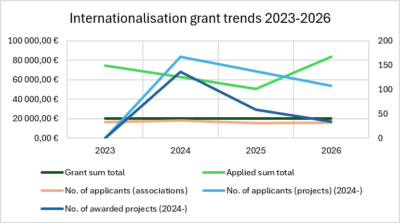
As with the cultural grant, challenges have been identified with internationalisation grant as well. However, the challenges concern the targeting of the internationalisation grant more than the sufficiency of the grant. The number of applicants and the sums for the internationalisation grant have grown, but the sum to be distributed has not. For the internationalisation grant the change has fortunately not been as worrying as for the cultural grant. The total application sum was about 74,500 euros in 2023 and about 83,500 euros in 2026. The number of applicants has stayed roughly the same from year to year, and the number of individual projects has even fallen steadily since 2024, when there were 167 projects. This year there were only 107 projects. On average, the grant has been awarded at a little over 600 euros per association in each year between 2023 and 2026.
As with the cultural grant, the future of the internationalisation grant will also be considered in August in cooperation between TREY and the university, so that the grant meets the needs of both the university and the student associations.